
Farming is the biggest lever on a settlement's food supply, and the easiest system to get quietly wrong. A field that looks fine can be losing you half its yield to a bad rotation or an oversized parcel.
Keep fields small, roughly 0.5–1 morgen each. People can't work a field while an ox is plowing it, and sowing waits for the whole parcel to finish. Several small fields let labour and oxen run in parallel where one large field forces them to queue. Total yield across the same area is identical, so splitting costs you nothing.
Respect the fertility pools. Wheat and rye draw from the same pool, as do oats and barley. Pairing either couple in one rotation craters the second crop. Safe rotations pair across pools: wheat–barley on one field set, rye–flax on another. Three different crops removes the need for a fallow year, since fertility regenerates per crop group over roughly one growing year and two recovering.
Staff to the land, not the building. One farmhouse with two oxen and three families comfortably works about three morgen. If you run several farmhouses, restrict each one's work area. Left unrestricted, everyone drifts to the same corner and the outer fields miss harvest.
Bees are the cheapest yield you can buy. Each apiary adds about 2% across the region, five give 10%, and the bonus reaches orchards and vegetable plots as well as fields. At 50g a hive it pays back inside the first year. Size the apiaries for your region, and check the meadow percentage first, because meadow sets both the yield per hive and how many hives the land will carry.
 The Farmhouse Cluster
Farming & Fields
People can't work a field an ox is plowing, and sowing waits for 100% plowed, so small parcels let labor and oxen run in parallel. Total yield is identical. Oxen also waste time turning at row ends on an oversized field, and harvesters carry crops to the field's center. Both favour narrow fields.
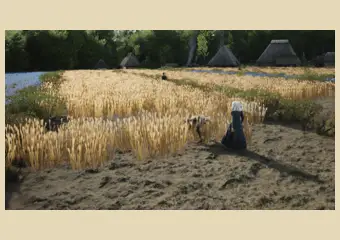
Unrestricted, everyone drifts to one corner. Too many hands on one field and the others miss harvest. Restricted, they split and finish everything.

Even wheat–rye–fallow craters the second crop's yield.
Rough annual output at a well-sized plot: beets ~105, carrots ~125, cabbage ~140. A sensible planting order: beets first for a fast food fix, cabbage for the best long-term yield per labor, carrots last for variety once you're stable.

Quince pays back fastest; apples and pears take longer to bear fruit but produce more once mature.
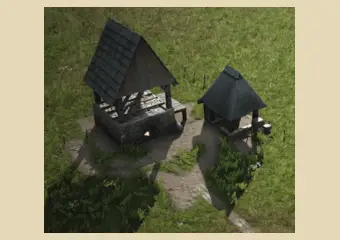
It takes about 2 years to yield anything. A fast vegetable like beets always wins when you're short right now.

Same trap as wheat and rye (#54): treat oats and barley as competing for the same soil, not independent crops.

The field needs at least one crop planted first; burning sacrifices that season's harvest but gives a bigger, faster boost than multi-year fallow.
Removed. Fallow, rotation and field-burning are your only fertility tools now.

Rough community-tested figures (no official numbers exist): sheaves on the ground lose ~10%/month, dropping to ~3% once carried into the farmhouse and ~1-2% once threshed into a granary. Rain adds a random extra spoilage hit on anything left outdoors.

That is the real farming calendar, and it is why a field sown too late is wasted labour rather than a smaller harvest. Plan backwards from November, not forwards from spring.
Read all 25 Farming & Fields tips in the field book →
New in the Beta — crops
Oats share fertility with barley but tolerate poor soil far better, and threshed oats can be eaten directly. Ideal for feed regions.
No windmill, communal oven or bakery needed. Harvested oats go straight from threshing to the table, or to animal feed.
Use high-meadow regions for honey and crop yields, not for growing a herd faster.

Read the full Beta chapter in the field book →
Read these next

Food & Population
Every harvest ends up in the winter stockpile. The food guide sets the number your fields have to hit by October.

Sheep & Pastures
Oats grown for people also feed the herd. In the Beta, fields and pastures are one planning problem, not two.

Trade & Wealth
Surplus grain and flax are among the steadier exports once the granary is safe.