A fan-made companion · patch 0.8.100 notes
Pick a good and a quantity. Get every stage, every building and every raw input the chain needs, down to the soil.


 —
— ——
——How many of each building? This tool will not guess. Nobody has published per-building output rates and we have not measured them, so the numbers above tell you what each stage must carry, not how many workshops carry it. Watch for the stall. Whichever stage runs dry first is the one to duplicate.
Ratios from patch 0.8.097 recipes. Raw resources (grain, ore, clay, wool) assume adequate land and deposits.
Almost nothing in Manor Lords comes from one building. Bread needs a farmhouse to grow grain, a windmill to mill flour, and a bakery to bake it. Three separate buildings, each staffed by its own families, each capped at its own output rate. Ale needs barley grown, malted, then brewed. Even a single spear traces back through a mining pit, a bloomery and a smithy before it reaches a militiaman's hands. The Craftsman's Calculator above walks that whole tree for you. Pick a good and a target quantity. It resolves every upstream building, the monthly throughput each stage has to carry, and what raw resources (grain, ore, clay, wool) the chain consumes.
The number that matters is chain depth: how many production stages sit between your raw resource and the finished good. A shallow chain (firewood, planks) is forgiving. One bottlenecked building slows that one good and nothing else. A deep chain (mail armor: ore → slabs → tools/parts → armor) means one understaffed link stalls everything above it. Building the top of a chain before the bottom is the most common way new players end up with a bakery that never bakes.
Drag to pan, or enlarge for the full-resolution chart.
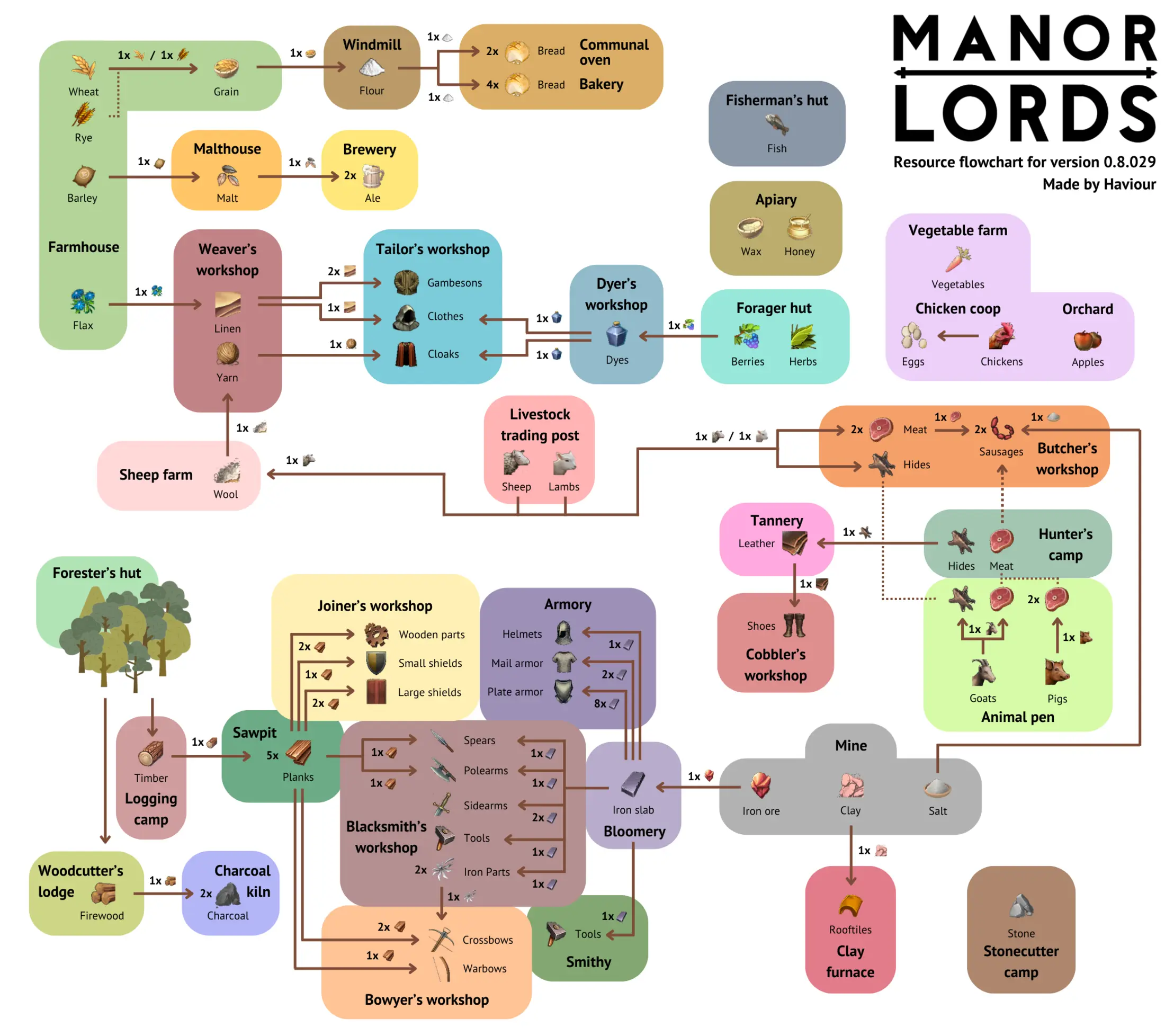
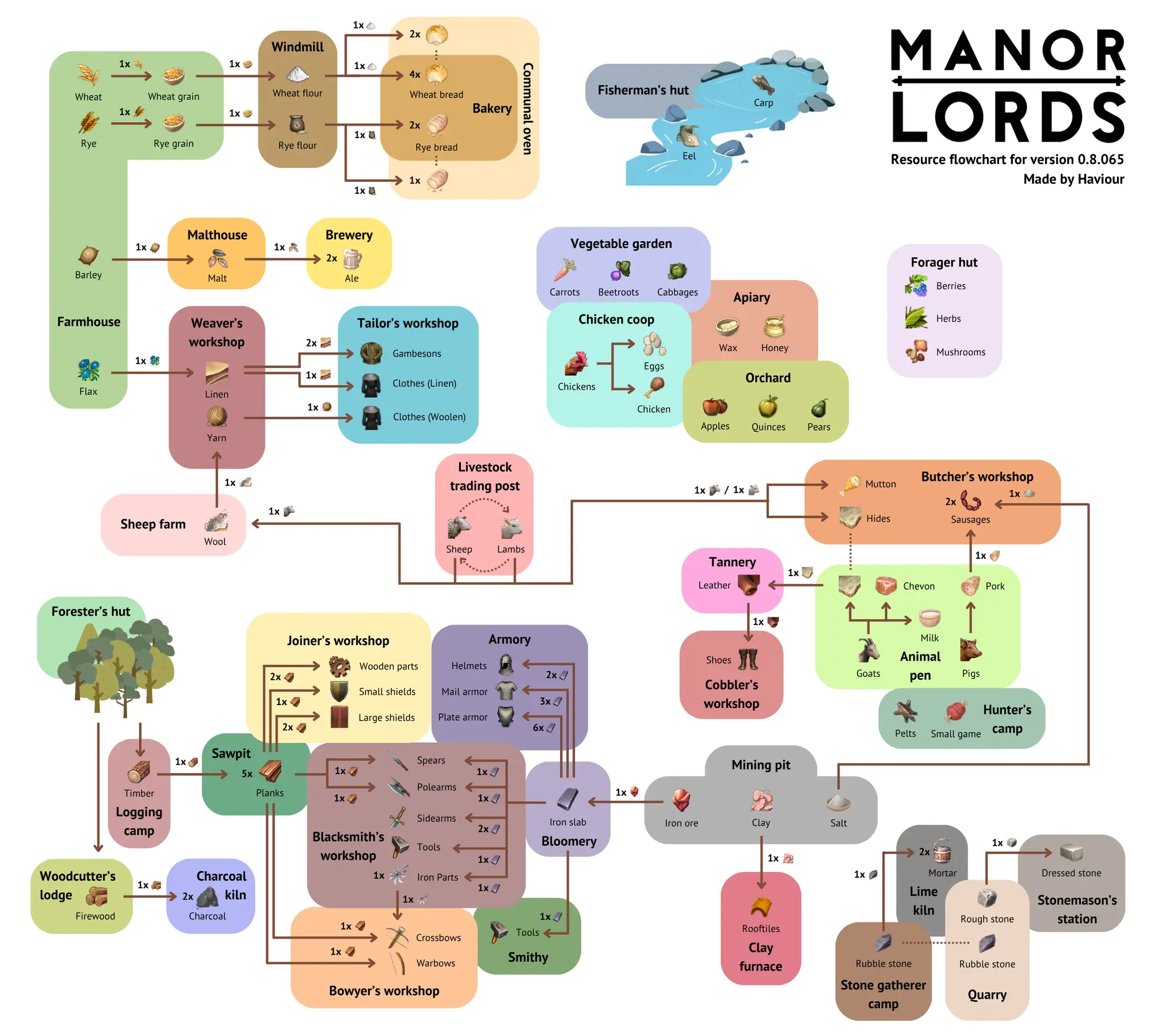
Hover or tab to a building name for its cost, worker slots and inputs. Rows marked no atlas entry yet are buildings the game has and the wiki has never catalogued, so they carry staffing and recipe but no build cost.
BloomeryCost 1 Timber
 6 PlanksSlots2 maxStores50 genericNeedsIron Ore→
 Iron SlabsCharcoal KilnCost2 timberSlots3 maxStores50 genericNeedsFirewood→
 CharcoalClay FurnaceCost1 Timber6 Planks
 8 Rubble StoneSlots5 maxStores250 genericNeedsClay→
 RooftilesFarmhouseCost3 timberSlots8 maxNeedsWheat · Rye→
 CropsFieldStoresVariable→CropsFishermans HutCost2 TimberSlots3 maxStores50 pantry→
 Carps
Carps EelForager hutCost1 TimberSlots4 maxStores50 pantry→
 Berries
 Herbs (with upgrade)Hunting campSlots3 max→
 Meat
Meat HidesLogging campSlots3 max→TimberMalthouseCost2 Timber6 Planks12 Rubble StoneSlots2 maxStores12 generic · 100 pantryNeedsBarley→
 MaltMining pitCost4 PlanksSlots4 maxStores50 generic→
 Iron ore
 Clay
Clay SaltPastureStoresVariable→
 WoolSawpitCost2 TimberSlots1 maxStores50 generic · 5 log storageNeedsTimber→PlanksSheep farmCost2 Timber6 PlanksSlots3 maxStores50 generic · 5 livestock→WoolSmall tavernCost3 timber4 planksSlots1 max→EntertainmentSmithyCost1 Timber4 PlanksSlots2 maxStores50 generic storageNeedsIron Slab→ToolsStonecutter CampCost1 Timber4 PlanksSlots4 maxStores50 generic→
 StoneTanneryCost2 Timber6 PlanksSlots3 maxStores50 genericNeedsHides→
 LeatherTrading PostCost4 timberSlots4 maxStores500 generic · 500 pantry→TradeWeavers WorkshopCost4 TimberSlots3 maxStores50 genericNeedsFlax · Wool→
 Yarn
Yarn LinenWoodcutter's lodgeSlots3 maxStores50→
 FirewoodWooden churchCost2 timber20 planks10 stoneSlots1 max→FaithAnimal penWikino atlas entry yetPorkraw resource, no inputs→
 PorkArmoryWikino atlas entry yetHelmets2 Iron Slab → 1 HelmetsMail Armor3 Iron Slab → 1 Mail ArmorPlate Armor6 Iron Slab → 1 Plate Armor→
 Helmets
 Mail Armor
 Plate ArmorBlacksmith's workshopWikino atlas entry yetIron Parts1 Iron Slab → 1 Iron PartsPolearms1 Iron Slab → 1 PolearmsSidearms1 slab → 2 sidearmsSpears1 Iron Slab → 1 Spears→
 Iron Parts
 Polearms
 Sidearms
 SpearsBreweryWikino atlas entry yetAle1 malt → 2 ale→
 AleButcher's workshopWikino atlas entry yetSausages1 pork + 1 salt → 2 sausages→
 SausagesCheesemongerWikino atlas entry yetCheese1 milk + 1 salt → 2 cheese→
 CheeseCobbler's workshopWikino atlas entry yetShoes1 Leather → 1 Shoes→
 ShoesCommunal ovenWikino atlas entry yetRye Bread1 rye flour → 1 rye breadWheat Bread1 flour → 2 bread (4 at an advanced bakery)→
 Rye Bread
 Wheat BreadJoiner's workshopWikino atlas entry yetLarge Shields2 Planks → 1 Large ShieldsSmall Shields2 Planks → 1 Small ShieldsWooden Parts2 Planks → 1 Wooden Parts→
 Large Shields
 Small Shields
 Wooden PartsLivestock farmWikino atlas entry yetMilkraw resource, no inputsWoolraw resource, no inputs→MilkWoolStonemason's stationWikino atlas entry yetDressed Stone1 Rough Stone → 1 Dressed Stone→
 Dressed StoneTailor's workshopWikino atlas entry yetCloaks1 Yarn → 1 CloaksClothes (Linen)1 Linen → 1 Clothes (Linen)Clothes (Woolen)1 Yarn → 1 Clothes (Woolen)Gambesons1 linen → 2 gambesons→
 Cloaks
 Clothes (Linen)Clothes (Woolen)
 GambesonsWindmillWikino atlas entry yetRye Flour1 Rye Grain → 1 Rye FlourWheat Flour1 Wheat Grain → 1 Wheat Flour→
 Rye Flour
 Wheat Flour
No producer matches.
Every stage above is families you are not spending elsewhere. Before you commit a workshop, check what the building itself costs, whether the good is worth exporting, and what the workers were doing instead.
Construction cost, workplaces and output for every catalogued building.

Which goods are worth selling processed, and why route costs climb.

Weigh the chain against your own food, fuel and families.
The artisan traps: conversions you can't undo, and workshops that never pay back.